Kobe, Japan
Sunday, September 26, 1999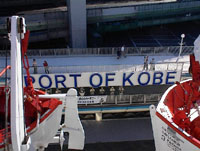
We just arrived in Kobe this morning after twelve days at sea and immediately set out to find an Internet café.
The third day out was rough and many people got sick. But the rest of the transpacific crossing was uneventful. We didn't see a sign of civilization - no boats, lights, or people - for about 10 days.
Getting familiar with the ship's patterns has been challenging for some people - getting to know people on board, getting used to the constant movement of the ship - so coming to land, our first port, was very exciting. The Field Office work that I'm doing onboard, helping to organize the 750 Semester at Sea participants' prearranged tours in 10 different countries, is O.K. although I'm glad we're here in port doing what we came for: visiting and learning about interesting countries. The ship has one satellite Internet connection through the radio room which is controlled by the ship, not Semester at Sea, so only official information is transmitted; we can use it for faxes but it costs a lot. Students, faculty, staff, and crew don't have any onboard access to the Internet.
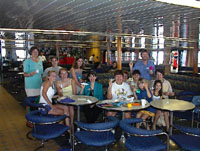
In anticipation of arriving in Japan, many of the ship's participants slept on observation deck last night, which offers the highest and best views for arrival at day break. For more than 12 days we have only seen water from this deck and any other; the rest of the world could have fallen away from our watery vistas for all we know. Last night, observation deck was like grand central station and people didn't sleep very much.
I slept well in my little cabin without a portal six levels down where it`s quiet and often too cold. Before people went to bed, a spontaneous party took shape on prom deck - which has a lovely, weathered, wooden floor under the open sky, a spacious area for eating, as well as a small swimming pool - with musicians from the student body. It was quite pleasant to be a part of the nice atmosphere. The musicians were good, especially the bass player.
I'm told some students have given up on studying already, while others are working quite hard. It's hard to find a quiet space onboard the ship to study since most students share cabins. The 650 foot ship with 950 people onboard is a condensed world. The captain makes his rounds daily popping in to many of the offices in a friendly way.
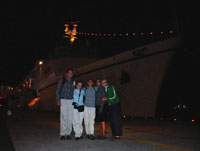
As we arrived we received a grand greeting from a local, Japanese firefighter's brass band playing marching music and later drummers and dignitaries came on board for a formal greeting ceremony.
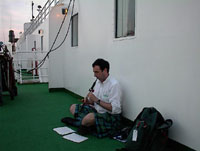
For some it might be easy to feel anonymous on our ship, the SS Universe Explorer, because there are so many people on board, although the youthful atmosphere, adventurousness and openness of people make this less likely. My bagpiping has not rendered me anonymous.
The sense of adventure of a world voyage, the group experience and the daily lectures which faculty deliver to the whole ship are quite fun.
We stay in Kobe for five days. Tomorrow I'll visit a Japanese family as part of a 'home stay' field trip.
Monday, September 27, 1999
We arrived in Kobe, Japan on Monday, September 27, 1999 at 8 in the morning after 12 days at sea. Due to customs we couldn't disembark until around 11 a.m. During that time an American consular representative, Douglas Muirs, and some Japanese representatives from Kobe came aboard to greet us. After Muirs debriefed us about recent Japanese/American events in and around Kobe, and encouraged us to behave, gifts were exchanged and we heard and saw some drumming.
Muirs seemed quite conscious of the impact of his words on both the American audience of 750 and the handful of Japanese audience. A couple of recent, serious, violent episodes where Americans were at fault provided the basis of his talk about how not to behave. His demeanor had a Japanese component, a strange overlay of deference in delivery of his talk and diplomatic circumspection, on top of American, dark-green-suited east coast intellectualism. He seemed to inhabit a role betwixt and between cultures. All of his words were weighted, as he himself observed, by saying that his talk about how not to behave came out more sternly than he wanted. In his brief overview of current Japanese/American relations, he talked about the Japanese move to the right.
The Japanese drumming had a comic element where drummers both cooperated and competed for access to beating the drum, first exchanging places rhythmically and according to plan and then bumping each other away combatively smiling all the while.
After doing some tasks for the Field Office, my parents and I, Joyce
Binam and Bruce Steele set off into Kobe to find an Internet café. We
had the name of the café, the building it was in and the train station
it was near, but not all streets are signed in Kobe. We took the Portliner
from the Port of Kobe into the central Sannomiya station and started to
walk. After finding the general vicinity of 'Netsurf' near the Motomachi
station and asking many people about its location, quite a few of whom
didn't speak English, we finally found the third floor, an 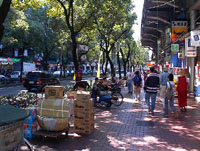 uncrowded
room with good computers. It was my first contact with friends from San
Francisco after 12 days. Because the machines didn't have telnet, my father
couldn't access his email. I'll bring a disk with telnet to the next Internet
café we go to.
uncrowded
room with good computers. It was my first contact with friends from San
Francisco after 12 days. Because the machines didn't have telnet, my father
couldn't access his email. I'll bring a disk with telnet to the next Internet
café we go to.
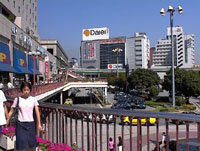
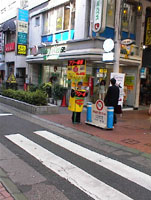
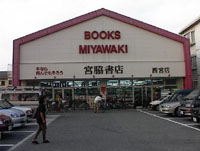
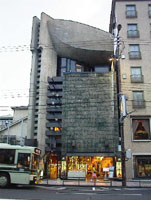
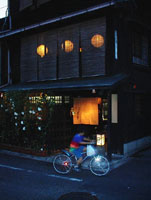
Kobe is urbanized. With so many shops at street level, narrower roads, a sense of age and stone, and the style of architecture, I was reminded of Paris' smaller out of the way districts. Kanji and romanized characters advertise many of the products, which are found in any urban center around the world. Many young people wear long hair. Women walking with sun umbrellas and multiple, chest high, tall, thin, flag-like advertising banners along the street are interesting.
Tuesday, September 28, 1999
Dear Henry,
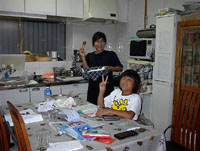
I can't type for long because I'm staying with a host family from the Hippo Family group outside of Kobe and it's breakfast time. Harumi is making an American omelet, but thanks for your nice letter. Visiting the Kobayashis overnight is one of the highlights of this trip so far. I'm working in the field office on board the Semester at Sea ship helping to administer the 30 or so trips that the 625 students and 125 faculty, families and staff go on in each port.
Wednesday, September 29, 1999
Fifty families from the Hippo Family group, a Japanese, intercultural friendship organization, came aboard the Universe Explorer yesterday to meet and take home 50 students from the ship. Students have rated this experience very highly in the past and it is certainly exceeding my expectations. It's a wonderful opportunity to live intimately with what the Kobayashis described as 'a normal Japanese family.' After the Hippo family organizers, Mr. Hori, Kami and others, made a presentation to the group about the Hippo family's process of learning a simple story in 7 to 15 languages using song and games and involving the whole family, the Kobayashis, with a friend named Satomi who was bringing home the student Emily Stone and I, got into an American-like mini-van to drive to Nishinomiya city.
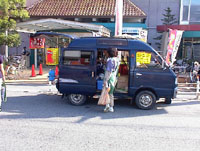
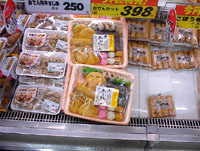
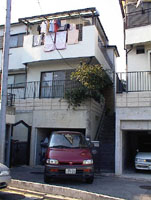
The drive east along a straight, heavily trafficked and busy road with very little greenery showed us a sprawling, urban Japan of shops and businesses, boxy apartment buildings, and a fair number of pedestrians and bicycles. One city ran into another. In the gas station, three young, male attendants, some with longish hair and ties tucked into their dirty shirts came to greet our vehicle ushering us to the pump with open arms. They washed the windows and acted extraordinarily helpfully. We stopped at a Japanese supermarket which was very similar to an American one in layout but had more refrigerators around the perimeter with more fish, fish products and condiments. Japan seems very orderly and safe with a very welcome, shared understanding of niceness and politeness; it seems like there is very little threat of crime, theft or aberrant social behavior. Japan is also one of the richest large nations on the planet. The Kobayashis - Yoshi (42), Harumi, Waka, and Yuki, live in a modest home two cities away from Kobe. I am their first Hippo visitor.
Wednesday, September 29, 1999, e-mail correspondence
Dear Yoshi and Harumi,
Many, many thanks to you, Harumi, Waka and Yuki for your very gracious hospitality. You helped to make my visit to Nishinomiya and Kobe very, very nice. By living with you and your family for two days and a night, I gained more insight into Japan and Japanese life than I might have in a much longer period of time living on my own in the area. I can't think of a nicer or more interesting way to visit a city and Semester at Sea's first port and it may well prove to be one of the nicest visits of our voyage. Please say thank you to Waka and Yuki.
Thursday, September 30, 1999
Kyoto was Japan's imperial city from 794 to 1868. It's cultural significance spared it from bombing during the second world war.
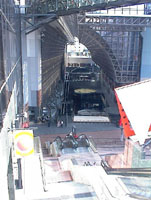
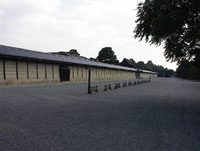
I took the J&R train line with Rosamond Hobart for a 50 minute ride to Kyoto for about 1050 Yen (about $10.50). We went directly to the Imperial palace at 11 a.m. to register for a 2 o'clock tour. Unlike most of Kyoto, the Imperial Palace is surrounded by extensive green hedges and inside this green wall is lovely, open parkland with the imposing, imperial compound in the center. After registering for a tour at 2 p.m. (which is actually like receiving an invitation from the Emperor) we took a public bus a couple of miles away to Ginkaku-ji, an exquisite place, and then returned to the Imperial Palace later.
During the Imperial palace tour, the guide emphasized the importance of rank during state visits at the palace, describing how the Emperor of Japan, Queen Elizabeth and George Bush could enter through one gate while Prince Charles, Lady Diana, etc., entered through a different gate on recent visits.
I met Sylwia on Kyoto bus 206 from Gion to the Kyoto train station last night. She was raised in Warsaw, Poland but is now studying literature, art history and philosophy in Germany. She was returning to her hotel as two friends and I were returning to Kobe. She mentioned that she had had an American philosophy professor at her university who talked a lot about Derrida and Foucault. She said that these writers were passé in Europe. She wanted to know about American philosophy, and whether such thinkers were actively considered in the university. I said that American philosophy is a little like an industry these days, producing more philosophy Ph.D.s than anywhere else in the world, that pragmatism was one of the only unique American philosophical 'products' and that while the European philosophers were certainly read and discussed, I didn't know what role they held in American philosophical thought presently. Specialization is one of the current trends in American philosophy. After completing her Ph.D., Sylvia mentioned how she may become a professor. She said that 'Beziehungen', connections, are as important in Germany as they are anywhere.
I asked her about Hegel's role in contemporary German philosophy and she shook her head negatively saying he wasn't actively and seriously considered these days. I mentioned Kant, Heidegger, Wittgenstein and Marx as being some of the most, influential, complex and challenging philosophers that students are currently considering. Heidegger significantly influenced Derrida and Foucault. Sylwia mentioned a contemporary German writer, Sloterdrek, who is interested in aesthetics and who is influencing a body of students today in Europe.
When I mentioned globalization as a current world trend and reality, Sylwia rolled her eyes and said, half smiling, "don't talk to me about globalization."
Sylwia, who seems to have traveled extensively, observed that Beijing, China is following an American pattern by building big, characterless buildings and putting up advertising everywhere. She said that in China anything American is good. She wasn't impressed with the way things were going in Beijing.
In Japan last night while riding home from Kyoto I saw huge neon signs advertising Hewlett Packard, Visa, and Friskies next to Japanese neon advertisements in Kanji.
In my limited five days in Japan, I've seen architectural and land use approaches exhibiting a certain way of thinking where extraordinary attention to detail is metered out in beautiful, ancient temples, modern housing and in products, but I haven't had any opportunity to talk with Japanese students about current Japanese thought.
Meegan, a chemical engineer from Penn State, and one of the students I rode home with, doesn't see any essential differences between Japan and the United States. Except for the language, the buildings, cars and clothes are all similar.
Thursday, September 30, 1999
Hello
Warm greetings from Kobe, Japan on our last day. In 4 hours we steam off toward Hong Kong, where I shall go to Si'an with its armies of life-size terra-cotta soldiers with unique faces and then to Beijing, which a friend on a bus yesterday in Kyoto described as trying to imitate the United States in its rush to modernize and increase its standard of living by creating characterless buildings with lots of advertising. I'll tell you what it's like after I get there. Products are also supposed to be inexpensive.
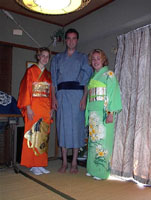
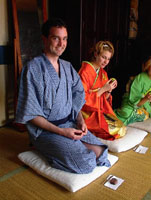
The most extraordinary experience so far in Japan for myself and 49 other Semester at Sea students, by all accounts, was an overnight stay in a Japanese home with 50 families organized by the Hippo family organization. Insight into the daily life, aspirations, gas stations, supermarkets, language, family dynamics, and dreams was highly rewarding. One evening, I and another SAS (Semester at Sea) student went to a potluck gathering with delicious Japanese food and families who are part of this Hippo group. The innocence of the parents as they sang songs and played games (like London Bridge is Falling Down, and Duck, Duck, Goose) while learning words in 15 foreign languages was striking. The children grew quite wild by the end of the potluck because the parents put no restraints on them. The parents in general were very loving with their kids and with the SAS participants. The mothers here hosted all of us in a very remarkable way. The next day three host families dressed 3 of us (SAS participants) in Kimonos, let us partake in a tea ceremony made especially for us with elegant soy bean, marzipan-like cakes and then made us Okonimakiya, a kind of Japanese pizza. In general, the Japanese are, as a group, consistently kinder, more helpful and polite than folks in the United States. As an outsider (Gai jin), one could bask in this friendliness for a long time.
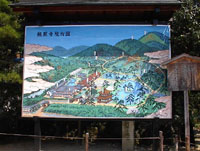
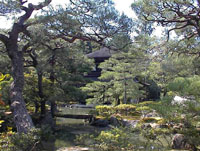
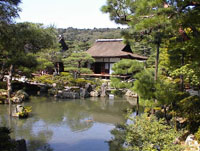
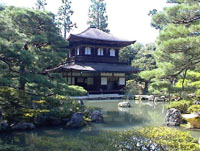
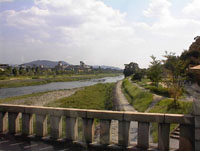
Yesterday, I went to Kyoto which was the imperial capital city of Japan from the late 700s A.D. until 1868 when Japan opened to foreigners. Now urbanization has engulfed the remaining architectural splendors in a sea of nondescript western looking apartment buildings. The majesty of the Imperial Palace and Ginkaku-ju (the silver pagoda) still stand. Ginkaku-ju with its mossy hills, its tree covered splendor and lovely ancient Japanese buildings and fish ponds makes it a wondrous oasis in urbanization. It's a UNESCO world heritage site. From Ginkaku-ju we walked along the philosophers' path, which is a lovely, old, winding canal dotted with plum trees whose branches cover the path in a green belt and then into a well-to-do neighborhood with very elegant and beautiful modern Japanese homes.
Unfortunately I haven't been able to connect my own laptop or bring a floppy disk with an upload program to put anything new on my web site, although I have taken many photos and videos which I shall post sometime. Had I brought a disk with an upload program to what seems to be the only Internet café in Kobe and which now has a line out the door as Semester at Sea students wait for their turn before the boat sails, I would have been able to secretly use the upload program to access my web site on half of the machines here. Many Internet cafés don't want foreign material such as floppy disks because of the risk of viruses.
In this Japanese port city of 2,000,000 where everyone seems to go out of their way to aid and assist people, wonderfully polite and kindly behavior seems to be the norm, in contrast to America where I feel there is more suspicion of and less uniformity of human behavior, more household security systems and worry about aberrant behavior across the many different groups and classes which make up U.S. society. And this is one of the richest lands in the world, significantly richer on a per capita basis than the U.S. If only the cities were a little greener and less compact. Kobe, while densely populated, is surrounded by forested hills and looks quite beautiful from the water.
Friday, October 1, 1999
I set off with my bagpipes and my kilt on this last day of our stay here to take a walking tour of Kobe, to visit museums and to busk. Bagpiping in a country where residents have not heard bagpipes very frequently is always enjoyable because people are generally very appreciative and touched.
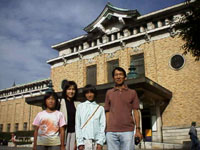
I first played in front of Kobe museum. Its collection emphasizes its history as a port city, its interaction with the west both before and after the Meiji opening of 1868, its modernism and its roots in neolithic times. The Japanese have a word for the study of western science called yogaku which they pursued during the Edo period, despite the closure of Japan, through their trading contacts with Holland. The Japanese were mostly interested in western medicine but also in astronomy, the solar calendar, world geography, physical science, and languages. The museum also seemed to point out that the Japanese also imported glass and telescope making from the west.
Kobe maritime museum is very interactive with exhibits that try to look into the past as well as the future of Kobe as a port. The museum has a 3 foot long ship covered with pearls and other valuable stones. The museum is situated in a building, on the sea front in this busy port, that is reminiscent of two sails. After the earthquake of January 1995, in two years the city of Kobe rebuilt the port, which accounts for 30% of all port trade in Japan and which was heavily damaged. During those two years of rebuilding, they used temporary quays to carry on the port's commerce.
After visiting these museums, I walked back through downtown Kobe to busk. I went to eat a lunch of noodle soup with chicken broth, green onions and two pieces of meat at a little restaurant near the big covered shopping area near Motomachi and Sannomiya stations and also near the Internet café. The woman who made the food gave me a green tangerine, probably because she was very friendly and I was a foreigner, wearing a kilt and couldn't read the Japanese menu. I paid her 500 Yen for the meal. I asked her if it was o.k. if I bagpiped outside her eatery and she said o.k. After playing a little while, she came out and put 500 Yen (about $5.00) in my piping box. I made $30 in about 20 minutes. As I was piping a woman came up to me and asked if I was coming to the Kobe Scottish Highland Games the next day. I knew that Tokyo has a bagpipe band but I was impressed that Kobe was having a highland games.
Nuclear accident. Upon returning to the ship, executive dean Ed Glattfelter called a mandatory, emergency meeting for all those who had traveled to Tokyo on the voyage. A nuclear reactor about 100 kilometers north and slightly west of Tokyo had malfunctioned and residents within 5 kilometers of the reactor had been evacuated. Ed wanted to know if anyone had been in the area around the reactor and to provide information to students for when they contacted their parents. The Pittsburgh Semester at Sea office had received numerous calls about the incident.